Monday, June 27, 2011

The Path of the Tornado

Ever think? That is, compose yourself for some good, old-time introspection?

Golf lends itself to introspection. Business, and the task of keeping your business open lends itself to introspection. Raising children should lend itself to the same task, where you wonder how much your own experience as a child will determine the efforts that you're willing to put into parenthood comes to mind. Raising a child used to be a more private affair. The values of the parents were directly imprinted onto the child. Nowadays, thanks to public schools, those values are being supplanted by the publicly accepted values, known as Liberal Belief.

In the past few weeks have been some clearly defined examples of chiaroscuro in American values. The easy one is the Wiener thing. The next? Gay marriage in New York. What is it that allows for certain gays to dominate the public debate over what is acceptable, or what isn't?

Gays have events that are unlike any mainstream event. Gay Pride is an example. My aunt lives in San Francisco, and so my mom and my aunt found themselves caught up in the latest Gay Pride parade in the City. These are old women. Together, their average age is within thirteen years of 100 years old. Imagine their pain, as they ask themselves, where is our culture leading us?

The "path of the tornado" is a line from a movie. Shawshank Redemption. Things blown up, out of all proportion. Not expected. Destructive.

I have a friend that does marvelous paintshop. Or whatever the program is that allows you to manipulate photos to come up with pictorial sarcasm. For some weeks now, I've wanted to ask him to produce a photo of a man taking a crap, on a porcelain throne, in the middle of a living room. With children, aunts and uncles surrounding this visual treasure. This is what the Gay Pride Movement represents to me. Just as I wouldn't want to exhibit to my children pictures of my going at it with their mother, so to would I wish that the sexuality of the homosexual limit itself to places where admiring adorers could savour the grace of their acts, without my having to pay homage to their particular choices.

Let me be clear: I believe that every person has a right to crap. In fact, as evidence of this, I believe that every home built in the United States today is required to build a special room--the bathroom--where a toilet is provided, capable of administering to the needs of each and every crapper, mandated by law.

The thing is, I don't think they normally build a crapper in the Family Room.

Homosexuality isn't necessarily deviant. There are Christians and Muslims who will tell you that homosexuality is deviant, and for some of these, the object of death by stoning. How can preference be considered deviant? Gentlemen prefer blondes. I like Ike. I'd rather be right. My preferences are my preferences. The preferences of Christians tend to be the preferences of fellow Christians. The preferences of Muslims tend to be the preferences of Muslims. The preferences of homosexuals?

I just don't believe that the preferences of homosexuals are represented by the advocates presented by such events as Gay Pride. See, I'm an old guy. I grew up around gay men and women, but never under the shadow cast by the GLBTWVXYZ  agenda. The first gay guy I knew was my Uncle Bill. Not really an uncle, but the son of one of my uncles. My Uncle Varner was the oldest of all my uncles at the time. And his oldest son, my cousin, was gay. Queer. Whatever pejorative you could wish to provide.

But Uncle Bill, an outcast, found a home in my grandmother's house. My grandmother, a devout Baptist. Uncle Bill wasn't really my cousin. And not, directly, my grandmother's kin. He was the son of my oldest aunt's husband, his second wife. And yet my grandmother, a holy terror when it came to the Baptist view of the world, was the only woman who would take him in. And when I was nine years old, Uncle Bill took me to the Centennial celebration of Idaho's entry as a United States' territory. It was an amazing event, with real, wild west events, like chuck wagon races and wild broncs. I like to think that Uncle Bill gained by my trust, as I know I enjoyed being the object of his care.

Being queer doesn't mean being a deviant.

Throughout my life I've come into contact with homosexuals. One of the greatest guys I know was gay, and the foster parent for several kids who had lost contact with their families. This guy reminded me of Johny Mathis. A great singer, an attractive man. A gentle poet. Being queer doesn't mean you're necessarily a predator. I would guess that years ago, being queer meant being more circumspect. In small towns, or in large cities, being gay meant having a certain shame, since being different in ones preferences meant that when confronted, one could be exposed as being a pervert, different, sinful--I'm sure a long list could be created.

I've no problem with teh ghey. Gay men or women don't shock me.

Since my Uncle Bill, I've had to deal with my fair share of the gay. But until I aged to my teen years, my contact with gays had always been of the sort of any child, a far away experience that didn't really relate to me and my life. My dad was a successful musician. My mom was a noted soloist. We, as a family, hosted singers and musicians into our home that were nationally and internationally noted musicians. One couple, a beautiful black man and woman, came into our house in the '60's, and when I noted their lack of shared last name was told, that "that didn't matter." They weren't going to have sex. They were the principles of a visiting opera company and were used to sharing rooms together. Portland, in the 1960's, weren't racially tolerant. They shared my mother and father's bedroom, as all our family shifted downward in our rooms. I ended up on the family-room sofa. The gentleman in question wasn't going to violate the idea of sex outside the vows of marriage. But, he did have a beautiful voice. (So did she.)

That homosexuality existed when I was a kid didn't have the effect that many seem to be labouring under currently; that we have a new, protected class of behaviour. That gayness needs to have new, previously undiscovered protections and rights that have never before existed. I don't think that is true. What I think is, that somehow Gay Rights has transformed into a campaign where taking a crap in the living room is equated with taking a crap in the bathroom.

Recently, the United States military has been directed to allow for gays in the military.

I am an old guy, sure, but I have two sons, 23 and 21 years old.

These guys know gays. They have gay friends. They look, as I hope I do, on gays as just being another choice. My youngest was recently in Hollywood as a tenant of a gay guy. Gay, by itself, doesn't denote nor connote anything worse than a preference in how one gets off. Baptists get off. Catholics get off. Atheists get off. We, most of us, get off. When asked, "what leading man's role in a movie would you liked to have had," answered, Some Like It Hot. I can't see a downside in playing Tony Curtis' role opposite Marilyn Monroe. And her dress in that pic was one of my first, and enduring, sexual preludes.
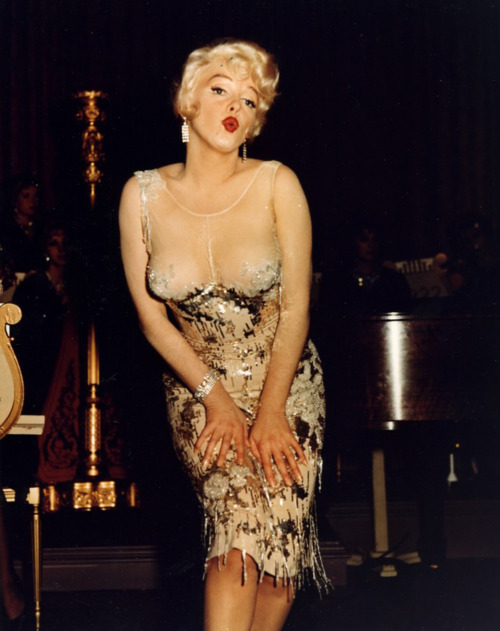
"
I am a victim of type.Sure. I'm not gay. How can I criticize gays for being gay, when I'm not gay?

That type of argument doesn't hold up. How can I convict the murderer, when I've never killed? Comparing a non-gay guy to whatever name is provided by the gay advocacy guys is ridiculous. I never "did" Marilyn. That doesn't mean I'm anti-Marilyn. And that, is the path of the tornado.

An attempt at beginning a conversation about differences has our nation at a point where we simply can't speak about ourselves and our held values, without ridicule. Which gets me to this point, "après moi le déluge." We end up worrying about gays, when the country is going around the bend.

"Après moi" may end up being the motto of our current President. "We are the change you've been hoping for," I believe is one of our President's lines. After me. And we're worried about the way we treat gays. Or, Muslims. Or , illegal aliens. None of these "issues" are important. Sure, there are weak kids being treated poorly by bullies. That isn't abnormal. Weak kids have always, and always will be, treated by kids differently. Which brings me back to golf.

Who wouldn't want to be a great golfer? For those of us who have swung a club, swinging a club well is its own reward. Playing golf poorly, too, is its own reward. But blaming someone else for one's own poor play is simply stupid. Either you play the game well, or not.

Same with life.

It's okay to talk about equity. In golf, we have the handicap system. Which players refer to, often disparagingly, referring to players as sandbaggers. A "sandbagger" is one who attempts to influence outcomes based upon an unfair recording of a player's record.

Sandbagging is an untoward behaviour. It is to be disparaged. Being gay isn't an untoward behaviour, in and of itself. It is when it comes in the form of crapping in the Family Room. There are a great many behaviours that have no place under public scrutiny. That idea was encapsulated in Griswold v. Connecticut, one of the worst decisions ever made by our Supreme Court. The intent was understandable. To make crapping in one's living room the law of the land. That Griswold was essential in Roe v. Wade is inarguable.

Law, too, has a handicap system. It's called stare decisis. And just as in golf, there is considerable sandbagging occurring in decisions by the Supreme Court. Griswold is one example. There are others. (Don't refer to Lochner!).

I don't care about gays. I don't care about your ethnic heritage. But I do care about gays who attempt to tell me that taking a crap in my living room is their right. Or, that folks who illegally cross our borders have the rights of citizenship.

If I'm a normal, being described as within a single standard deviation under the Bell Curve, human being, I think that my perceptions and my values are as worthy of consideration as those of those whose values, beliefs and experiences extend into the second or third deviations. If fourteen percent of a population believes that I should watch them express themselves as social deviants as their right to free speech, let them talk. When they extend that minority opinion as having the value of the eighty-six percent of us who believe that tortuous behaviours are simply tortuous, then,  that behaviour is simply uncivil. "Griswold" cannot be held outside of process. Private behaviours are not public behaviours.

It is a human right to take a crap. It is not a human right to crap where others are eating.

Accepting this algorithm is akin to accepting the path of the tornado. The tornado is destructive, and when able, to be avoided. Accepting the path of the tornado is simply dumb. Any politician, teacher or public apologist who offers less should be viewed sceptically. Another way to view it is, if it doesn't make sense, why listen?

Thursday, June 23, 2011

Gak

"In one corner of the ring are Science and Reason. In the other corner: Poisonous Polluters and Right-wing Ideologues."

This is a line from a former, United States Vice-President.

Life in his world is simple. Either you agree with him, which endows you with the qualities of "Science and Reason," or disagree with him, which makes you one of the "Poisonous Polluters and Right-wing Ideologues."

Hip and edgy. A two-fer.

This is the level of debate that one finds consistently from the Left. Why would you want to listen to someone easily identifiable as the "Poisonous Polluters and Right-wing Ideologues?" What purpose would there be to dip into the slime of such anti-science and anti-reason notions? Protein Wisdom offers an opportunity to ask how important framing the debate is.

Compare and contrast to Al Gore here. (h/t Watts Up With That.)

Friday, June 17, 2011

In the Valley of the Blind, The One-Eyed Man Will Be King

In the Valley of the Blind, the One-Eyed Man will be king.

No mention of the man with two eyes.

Depth of field. Simple notice. The eye plays tricks. Living in the Valley of the Blind, the voice of the alarmist is greatly exaggerated. We cannot see for ourselves, so we do the simply easy thing; rely upon the voice of alarum.  We have institutionally plucked an eye from the voice that sets the alarm. Hemingway was right to warn us*. Laocoön was institutionally unable to move the Trojans. (You actually have to read the book to get the reference to Laocoön, you're not going to find it in any on-line critical review.)

Reading Aeneid, you're not really enamoured of Laocoön. He's a minor character. But inescapably, in the literature, significant. Not, perhaps, the literature being taught today. But literature, when the quality of literature had been  important in the process of discerning the critical distinctions between merely strongly felt belief and truth. It isn't mere coincidence that Schopenhauer found a certain intellectual constancy with works of art that "transcends spatial and temporal determinations, the desires that derive their significance from one's personal condition as a spatio-temporal individual are seen for what they are, as being grounded upon the illusion of fragmentation, and they thereby lose much their compelling force." (Stanford Encyclopedia of Philosophy, Nov 17, 2007.) It is, in fact, the artfulness of the one-eyed man that I would suggest we find his claims so appealing. Whether or not you're an adherent of Campbell's beliefs isn't important. The fact that you come to Campbell, willing to believe his assertions without the benefits of two eyes, is. Schopenhauer viewed the world with two eyes. I believe he remains, currently, discredited. While the one-eyed view of Campbell remains all in vogue.

It is essential that one not lose faith with the senses with which one greets the world. More importantly, that which one views with both eyes. For the normative theorist, I assert that as much as there is validity in the view that the non-rational is important, and yet that,too, the rational is also important. There is, I would assert, an important distinction between the world viewed with one eye, than that same world, viewed with two. Much of modern thought or, post-modernism, is reliant upon a form of unity in viewpoint, that is non-rational, than that of rational thought, and what the Enlightenment Period would refer to as Rational Thought. The argumentation of the dualist has been discounted to such a low level that an attempt to impose the rules of logic and empiricism to argumentation today are relegated to what may be viewed as the ash-heap of history. They aren't relevant if they don't advance our stated outcomes. That is, we can discard those ideas that don't advance our own notions of what the outcomes of our actions should be. It is a view of the world with one-eye.

While going over the ideas that I wanted to represent with this post, one thought kept popping into mind, "what type of Egotist (ego-centrist) would allow this kind of thinking? How could I begin to think that 'my' thinking could have a greater relevance than the thinking that takes place around me? Why should my perceptions of what I view be given greater credence than the perceptions advanced by the singularly envisioned?"

An impulse to say or tell the truth, choked in an attempt to avoid the label, ego-centrist. 

Simple. Demagoguery. 

In the Valley of the Blind, the One-Eyed Man will be King. The one-eyed man has a certain, definite advantage over the dually sighted. There is no depth of perception. And one-dimensional viewpoints, while not representative of the world we live in, and are in fact more cartoon-ish than descriptive, may have the advantage of only representing a single thing by itself, rather than the relationship that thing may have to other things that may or may not be relevant to our ability to value that "single thing."

How do we continually excuse thinking forms that exclude logic or consistency?

After the fourth or fifth attempt to frame the thesis of this post, it became apparent to me, that I became as much a victim of politically correct thinking as has been the youngest First Grader upon his/her first day of school.

I am as much a victim of fifty years of tolerance training as the next guy. Even though I find myself facing ridiculous examples of erroneous thinking on the Left, from Homosexual Rights, to a Woman's Right to Choose, to the need to teach our six-year old children about their sexuality, I find myself caught withholding my own, personal vehemence towards these initiatives as a signature of  my intolerance to those who are different.

This clear, firm postulation of a thesis is today socially derided as a form of social injustice. And social injustice is a bad thing. (For a totally ridiculous article on "social injustice," see here.The article was written in 2004, before clinicians agreed that the cellular sufficiency for cancer lay dormant within all of us. This article is just another example of how issues of how advocates of "social justice" wish to advance an agenda that attempts to blind us to certain empirical and observable data sets.)

A simple thought problem; what is your strongest, held belief? 

I believe that taking a crap in ones' house is acceptable. I believe that taking a crap in ones' hosts' house is acceptable. I believe that taking a crap in ones' hosts' living room is unacceptable. Not the mere taking of ones crap. If you, or your host, has either an outhouse or bathroom, taking a crap is an expected behaviour. That is, the taking of ones crap in a manner which is acceptable to the standards of politeness and civility is a crap worthy of taking.

As much as my training, as the product of teaching or as of temperament, has been conditioned toward the elevation of my ideals, I find that I'm constrained by those ideals in ways that others aren't. Mere assertion of a thing is not, in the way I think, sufficient for either my holding a belief, of for the beliefs held by others.

I don't have a problem with homosexuality. I have a problem with the exhibition of homosexual crap in my living room. I don't have a problem with your assertion that a Woman's Right To Choose is your held belief. I have a problem with your suggestion that killing an unborn child isn't killing an unborn child. You may wish to crap in my living room. I would hope you find the civility to refrain from doing so. You may wish to kill your unborn child. Please don't expect me to accept the death of your child as your right. I view your child's rights as highly as I view yours.

I've had several conversations today about the sad state of Language Arts in our public schools. It seems that the narrative form that relies upon the statement of a thesis, and then is followed by an argument, has all but been expunged from our public schools. The level of what passes, or parses as argumentation, for language arts today, barely surpasses incoherence. Not always, successfully.

But, what is your answer to the question posited above? What is your strongest, held belief?

 Mine is simple. The belief that often sufficiency, when knowledge is uncertain, is sufficient. That knowledge isn't always necessary for action. That knowledge, while preferable to belief, isn't always available. And the relative uncertainty of belief isn't sufficient to deny the individual responsibility any person faces when faced with the necessity of action.

You may choose to believe that you're not required to be responsible for taking an action. In the Valley of the Blind, the One-Eyed Man Will Be King. The appropriate question for one's self should be, am I blind, singularly-sighted, or stereo-optically sighted?


The Myth of the One-Eyed Man can be traced back several hundred years. The popularization of the myth is attributable to C.S. Lewis.

The important moment, whether through the retelling of the mythic, or the story of Lewis is, is that the assertion that one can have a clear moment of assertion of positive truth may either be a gift or a sin.

The Value of the One-Eyed Man

What advantage is held by the One-Eyed Man? In the Valley of the Blind it is his sight. But, more importantly, his ability to use to his own advantage, the merits of sight to gain the allegiance of others, based upon his sight; that he alone can see.

This is an assertion. How can the blind actually know whether or not the sighted man has sight, or not?

The One-Eyed Man attempts to raise ideas to levels of thesis, posited as observations. Then, these observations are often posited as thesis/theses. Then, there are those who would use both their views or perceptions and/or others' inability to view or perceive, as an ability to expostulate those views or perceptions as having sufficient influence in order to assert argument. An assertion of argument that fails as thesis and as that which fails as a statements of thesis, which is no more nor no less than that of mere assertion fails the definition as either thesis or argument.

But, based upon a one-eyed view, upon evidence that is only discernible to the one-eyed viewer or their adjuncts, the blind, who are willingly able to accept the advice and wisdom of those who proclaim superior knowledge, as they are, the one-eyed men. That is, their willingness to assume that the mere assertion of a thing has the validity as that which is either based upon empirical evidence, or, assuming that logic is capable of playing a role that can show the meaningfulness of ones perception, thought and logic, as that of  an a priori ability to perceive that which is possible, than that which is not possible. (Yes, I know that I'm setting up another scale of believability, but that which can be shown, a priori, to be impossible is another valid form of argumentation. Perfect triangles aren't possible. But they are, by definition, perfect ideals of that which is both true, and unknowable.)

The value of the One-Eyed Man is thus; we know that his ability to see is limited. He will assert that knowledge of any system of duality is unnecessary. That is, it is sufficient that one only be able to pay attention to his (The One-Eyed Man's) observations and his views in order to be fully informed as to that which is necessary for holding the views and beliefs necessary to live life as a fully informed member of the society within which he finds himself. According to the One-Eyed Man, who would be King. Choosing a different life than that which the One-Eyed Man would accord you involves a certain risk, especially if you are blind. How many times must you hear, "Don't step there!" before you begin to ask yourself whether or not this advice is worthy, or not?

Being blind? A real handicap. Finding yourself reliant upon a one-eyed man?

How would you know?

*(The Sun Also Rises, Ernest Hemingway, October, 1926, Scribner's.)

Monday, June 13, 2011

What Determines Price II

Some of the words you're going to be reading.


Command Economy
Micro-economic
Market forces
Economic analysis
Equilibrium
Gresham's Law
Price Theory
Value
Externalities
Internalities
leakage
maximize
inefficiencies
cost
price
potential
opportunity cost


It is not embarrassing to find that you do not know a thing. It is true that the manner and number of things I do not know exceeds my ability to either know, or to number. What I am attempting to share with you, is a manner of speaking about things that either you or I face in our day-to-day travail. To allow you to question the precepts that have been adopted by the elite amongst those we refer to as "economists," and to allow you to question the priors that are, and have been, expressed here. Knowledge and understanding exist hip to thigh. You cannot know that which you've never questioned, and you cannot understand that which you do not know. I am attempting to put into layman's terms questions and concepts of economic theory which have heretofore been only available within texts that tend to suppose a certain level of math, language and training. I wish that at any point, with any question, you hit the comments tab and ask. No question is too dumb. The Elite that are attempting to dominate the political discussion offer you promises that no sane or rational man would ever utter. Finding the voice with which to criticize this elite is the responsibility of every man jack of us. Finding the rationale with which to attack the arrogance and stupidity of these jackals is incumbent upon the caring, thinking citizen. The rhetoric of the attack on individual liberty is, at times, difficult and convoluted. It is my task to introduce you to both the theories and rhetoric of the Elite. And to point out how easy it can be to poke holes into the balloons of their fanciful ideas and beliefs. If you have a question, to not ask is your fault. I will answer to the tenth degree, if necessary.

Discussions of economic policy tend to adhere to a rigid form; what is the expected outcome?

When we were talking about Bill and his scheme to pay his bills through the sale of marijuana, the expected outcome of Bill was to pay his bills. The concerns of an individual economic player, firms, businesses, are referred to as micro-economic concerns, that is, the roles played by individual or individual firms when faced with market forces. At every step of economic analysis is the condition that the activities of individuals, or groups, are facing the forces that are created by the production, sale and consumption of goods and services. Free markets, or capitalist markets, are determined by the choices made independently of others as to whether or not buy or sell any particular good or service. That is, again, a decision that is made by independent individuals, without the exercise of any outside influence on the decisions being made.

Command economies, as the name infers, are based upon a different set of conditions; what is allowed.

It is true that I am a Capitalist, since I believe that you and I are the best people to rely upon for information that decides our actions in the market for goods and services. I am best able to determine that which I choose to produce to enable my existence, just as I am the best able to determine which goods and services I will buy to effect the continuance of that existence. In a Command Economy, these choices are secondary. What is best, in terms of what I produce or consume is determined from an outside authority.

This is the critical moment between liberty and slavery. The free man cannot be made to do what he wouldn't do if given the choice for himself. The slave receives that which his master allows. I'm not going to spend any time talking about the form that master takes; it is sufficient for my purpose to assert that any choice I make that is limited by the coercive authority of another is a limit on my individual liberty. And the alternative to liberty is slavery. Ask yourself, if you are not free to choose, are you free or not?

This distinction, between choice and mandate is an important one. Markets have an existence, whether or not the State wishes them to exist or not. That is, while there are those that would wish to impose obedience in markets through the controls of state functions, whether they are regulatory or police agencies, markets tend to find equilibrium, even when production is determined through centralized state agencies. Take, again the instance of Bill and his sales of marijuana.

Marijuana is an item of contraband. That is, it is illegal to possess marijuana. For decades, the possession or sale of marijuana has been outlawed by our states' and by our national governments. And yet, the market for marijuana has persisted. How has this occurred? Simple. And it is the first step toward understanding one of the contradictory evidences of economic theory; Gresham's Law.

Gresham's Law is fairly simple in its formulation; bad money drives good money out.

My first practical experience of Gresham's Law came after my first trip to the Former Soviet Union. Remember, we're going to explode the myth that graduate degrees depend upon a renewed examination of price theory. Price theory is easy. People pay the price they think is fair. Price theory is the simplest of all theories. What did Jack pay for his Magic Beans? One cow. Was that a fair price for Magic Beans? Jack thought so, and so did every reader of "Jack and the Beanstalk."

But, given Gresham's Law, would bad beans drive good beans out?

Looking at markets, constituted of both buyers and sellers, if I came onto the market with beans, what would the market require of my beans before the sale of a few beans were to equal the value of a cow?

Bill had that problem when trying to decide the price of his marijuana. His really good stuff was twice as good as the commercially available stuff. His pricing problem was based upon an external. Not the value of the good or service itself, qua marijuana; but the production cost of the really good stuff compared to the production cost of the commercially available marijuana. Irrational mandates need not be applied externally, they can be adopted mandates, as well. Selling marijuana, trafficking in juvenile prostitutes, hiring out as an hit-man are all possible examples where mandates are imposed on the actions of the individual that can either be imposed externally or internally. Moral and ethical values in transactions are imposed every day, upon trillions of transactions. Or not. Sometimes moral values overwhelm the true transaction value, as in the case of deciding to not engage in trafficking in juvenile prostitution. While trafficking in underage prostitution may not have the moral proscription in some countries as it has here--in the main--it is difficult to countenance the trafficking of underage prostitution, while prostitution in general may not only be accepted as a suitable profession, but legal under the current statutes of some states.

So, it is possible to come up with encumbrances upon price that exist externally to the value of a thing. That, in and of itself does not repudiate my assertion that price theory, while a large part of the body of economic study, is simply an idiocy of the science. Buyers determine price. Under all states and all conditions. Unless that purchase of that item is mandated externally. Then, all bets are off.

Bill was operating under the external constraints of pricing theory that depended upon his acceptance of the Labour Theory of Value. Accepting the external constraint of a moral authority which would determine price outside of the values determined through the willingness of the consumer to pay more is an economic leakage. The value of Bill's really good stuff would allow for a higher level of income for Bill, if Bill's activities weren't limited by his moral beliefs. Worse yet, for the consumer, was the action of Bill's supplier, Miguel, who confiscated all of Bill's really good stuff, under the mandate that Bill only sell Miguel's commercially available stuff. Miguel mandated the level of quality that the market would be able to consume, while taking the more commercially viable "good shit" off the market. In exchange for Bill continuing to breathe. External mandates, which limit the flow and supply of goods and services coming to market also represent an economic leakage.

Leakages occur when forces that are external to markets limit either the abilities of the suppliers of a good or service, or the purchasers of a good or service, to maximize the value of their transaction. Leakages are the unrealized values of markets that tend to create inefficiencies in markets. Efficient markets are simple to understand; buyers and sellers come together for the simple purpose to buy and sell products. If buyers offer too little for goods, goods remain unsold. When buyers offer enough, or, more than enough for goods, goods are sold. If sellers price their goods at too high a price, their products remain unsold. When sellers price their goods at, or below, the selling price, the market will clear. That is, all products offered for sale will be sold. The market clears. The market achieves equilibrium. A market in equilibrium doesn't have leakages, since the definition of price and clearing depends on some simple agreements: prices that occur without externalities are those prices that producers willingly offer for sale their products; prices that occur without externalities are those prices that buyers willing offer for the purchase of goods and services.

The moment that Mikey stepped in and demanded that Billy purchase and sell his weed, was a major moment in the imposition of externalities. And Billy's reticence to price his good shit is a laughable concern, since the internally imposed restrictions were also costs faced by his potential customers. Gresham's Law is probably better understood in the light of these internally and externally imposed costs.

Cost. According to my 1934 Merriam and Webster:

cost: n.(as., fr. ON. kostr condition, chance, choice; akin to E. CHOOSE.) 1. Manner; way; means. Obs. 2. Characteristic; disposition; quality; value.

cost: n. 1. The amount or equivalent paid, or given, or charged, or engaged to be paid or given for anything bought or taken in barter or for service rendered; charge; price; hence, whatever, as labor, self-denial, suffering, etc., is requisite to secure benefit.

This explains, in many ways, why there are so many papers written about the theory of price, when the actual discussion should be placed on an understanding of cost. Somewhere along the way, economists decided to place the question of cost on the supply side, while abjuring the question of price on the demand side. But cost is the price the purchaser is willing to pay; that is, we are all participants in the process of supply. Every consumer is a willing participant in the supply process. The product of this process remains in too many cases either undefined, or undefinable. How to define the value of a process that results in the imposition of moral forces that wreck the balance between buyer and seller? By defining price as different than cost. And yet, linguistically, we find that cost and price are equivalent. My advice to the Academy is that someone turn on the lights.

Cost is price. The advantage to the neophyte in recognizing the equivalency of price and cost, is that the concept of opportunity cost is a lot more understandable. Economists, like most cliques of the elite, are more than willing to employ language that is in the main, indecipherable. Look at the economic terms that have been introduced in this simple essay:

Command Economy
Micro-economic
Market forces
Economic analysis
Equilibrium
Gresham's Law
Price Theory
Value
Externalities
Internalities
leakage
maximize
innefficiencies
cost
price
potential
opportunity cost

Have a nice night. Thanks for your time. Remember, asking a question isn't a bad thing, it's the path to enlightenment.

Obama's Great Leap Forward

I don't know if you caught our President's speech today from North Carolina. While none of it was notable, what is notable is his reliance upon some catch phrasing that intimates that the Way Forward, or Winning the Future, is going to be reliant upon policies that are "aimed at accomplishing the economic and technical development of the country at a vastly faster pace and with greater results." It is his belief that policies "aimed at accomplishing the economic and technical development of the country at a vastly faster pace and with greater results" are needed and if "the people could be ideologically aroused and if domestic resources could be utilized more efficiently for the simultaneous development of industry and agriculture" that we can solve the problems facing our economy.

These undertakings are going to be down to the grassroots level, as we are able to mobilize a grassroots movement, working in "factories, communes, mines, and public works projects for manual labor and firsthand familiarization with grassroots conditions."

This is Obama's Democratization Campaign for Economic Development. This campaign will be noted for "a new socioeconomic and political system created in the countryside and in a few urban areas."

The quotations provided above are from China: A Country Study (Robert L. Worden, Andrea Matles Savada and Ronald E. Dolan, editors, GPO for the Library of Congress, 1987.)

What triggered this post can be found in the comments section of a post at The Volokh Conspiracy today.  "First, this presumes that power generation requires large-scale projects. What about distributed smaller scale systems, like rooftop generation? While there are issued with system stability and control (provision of suitable reactive support, for example), there is no reason to believe that these are insoluble." The image that came to mind was immediately forthcoming, pig-iron production during Mao's Second Five-Year Plan during the Great Leap Forward.

California is looking at adding more than eight thousand megawatts of additional capacity. And the commenter at Volokh gets all Green and stuff, and offers up "smaller scale systems," like rooftop generation.

Yes, it is true that under the Second Five-Year Plan, production of Pig Iron was increased. What was produced was valueless, although I'm sure, at the time, certain apparatchiks were quite willing to offer, "While there are issued with system stability and control (provision of suitable reactive support, for example), there is no reason to believe that these are insoluble", the truth remains "The Great Leap Forward was an economic failure. In early 1959, amid signs of rising popular restiveness, the CCP admitted that the favorable production report for 1958 had been exaggerated. Among the Great Leap Forward's economic consequences were a shortage of food (in which natural disasters also played a part); shortages of raw materials for industry; overproduction of poor-quality goods; deterioration of industrial plants through mismanagement; and exhaustion and demoralization of the peasantry and of the intellectuals, not to mention the party and government cadres at all levels."

It may be true that Mao is a personal hero for the President's coterie. He certainly has put into positions of authority many prominent Leftist/Communist/Marxist/Socialist ideologues.  Visit our current policies in international affairs, as currently being practised in our leadership in areas around the Horn of Africa. "The "soft" foreign policy based on the Five Principles of Peaceful Coexistence to which China had subscribed in the mid-1950s gave way to a "hard" line in 1958." Time has been compressed for illustrious leader, moving in a span of two-years from the "Five Principles of Peaceful Coexistence" to our current war-making in Libya and Yemen.

A Great Leap Forward. Winning the Future. Adolescent views on how markets "should work."

The parallels fail to surprise me.

Friday, June 10, 2011

Austan Goolsbee to Leave White House

Watching this guy since his rise to Chairman of the Council of Economic Advisers has been, to be blunt, a living nightmare. His inability to fairly represent the economic data has not gone unnoticed, and I wonder what the aspiring underclassman of UC will be thinking when presented with an opportunity to study under this guy. I had the chance to study with William Appleman Williams, but figured, why? He was, as advertised, a revisionist. Why study American diplomacy through the lens of the Socialist? The whole body of values that one would have had to adopt was exhausting in and of itself. How does adopting the view that property is theft advance any helpful inquiry?

So, farewell to Chairman Goolsbee. And remember folks, the country is in the very best of hands. Enjoy your weekend.

Thursday, June 9, 2011

Bill, or Bob, and Markets

One of my readers mentioned that my name for our drug dealing marketeer kept shifting between Bill, or Bob. Forgive me, if you can. One of the great things about blogging is, when you hit the "publish" button, you're done. The advantage Bob has over Bill is simple; one less letter. And when the fingers are flying, cutting down on keyboard time has advantages.

They are small. You might even call them, "marginal."

The word, "marginal" is an important word. Not just for economists, but for scientists of any sort; engineers, electricians, automobile manufacturers, home builders. Marginal improvements are small improvements, that over time can mean the difference between economic success or failure. Sometimes, you might here business reporters talking about "margin calls." What they are reporting is, that the purchaser of some intangible asset, having purchased that asset with only a small part of that asset's worth, is being told that the time has come for the payment for that asset be made in full. It is true, that in some markets, intangible assets can be purchased with only a modest outlay from the purchaser, relying upon the broker or dealer to carry the asset transfer, as a loan. Kids do it every day, promising to cut the lawn in order to get a new pair of kicks. At some point, the kid has to cut the lawn. Or, in this case, lose the kicks.

The word, "margin," is an important word for economists, since most of economic theory attempts to relay information that occurs within markets, both for the investor, but also for the public policy purposes of economic regulation. This, I hope, won't have to be repeated; I believe in a minimum of market regulation by the government. I do not believe in excessive attempts at market regulation. I'm not a market libertarian, although I want you to understand that most efforts at market regulation, even though such efforts may have names that attempt to promise cures for the excesses of the markets, are nothing more than the creators of unintended market lags, the effects of which will, in my opinion, serve more to obscure the research and understanding of markets than effect positive changes that benefit the players, both buyers and sellers, of any market. This extends from simple relationships, like those of Billy and his dope, to JPMorganChase, and their current policies to allow for short-term credit extensions to individuals, through credit cards.

Margins are important. If I'm an automobile manufacturer, and I can manufacture a car for a lower price,yet offer a competitive automobile, with fit, finish and features of my competitor, at a lower price--a marginally lower price--I may not be able to succeed in converting all buyers of automobiles into purchasing my car, but if I'm marginally successful in converting some of those buyers to my competitively priced, marginally lower-cost, automobile, I've opened up the possibility for making greater profits than my competitor.

This is an important distinction.

A few posts ago, Billy, our hippie, drug-dealing marijuana peddler, faced a conundrum; whether to sell dope with a low production cost at a price higher than the commercially available stuff, or to incorporate the ideology of the Progressive Movement (Communist/Marxist theories) by sharing the fruits of his labours based upon the inputs costs of producing this mad weed. It is important to remember, that any time anyone offers you a solution based upon the principles of Social Justice, that you remember that this is a person who is attempting to substitute Marxist, Communist ideology with Capitalism. The Labour Theory of Value is a central tenet of Communism and Marxism. Do yourself a favour, and simply Google "labour theory of value." I'm not going to tell you that all the pages are clearly Marxist or Communist, you do your own research. Whenever you hear a labour union spokesman talk about "fairness," remember of what constitutes fairness from the viewpoint of the Communist or the Marxist.

Profitability is the report card of the capitalist. Getting someone else to pay for your existence is the report card of the socialist. Whether it's food, shelter, clothing or medical care, if you rely upon someone else to pay your bills, you're a socialist. If you rely upon yourself to pay your bills, you're a capitalist.

But Bill really wasn't a socialist when he started selling weed. He needed to make about a thousand bucks a month to cover the costs of his existence. He had it worked out, that if he sold a minimum number of lids, he could cover his cost of existence. And yet, he had access to really good weed, that was twice as good as the weed he bought from his connection. But, it was virtually costless, to him.

How to determine price?

The reason why I chose a market, like marijuana, is important for economists. The sale of marijuana isn't taxed, so tax policies don't affect the sale of marijuana. Marijuana is illegal, so there isn't an open market for the sale or purchase of marijuana. Marijuana sales reflect the conditions facing a market with limited entry, for, although anyone could choose to sell marijuana, most people would find either the risks of breaking the law daunting, or, find that violating the law untenable or unthinkable, so it would take a special type of entrepreneur to enter the market. The thieving, lying, progressive hippie. Parfait!

The advantages for economic examination are bountiful. Since it is an illegal activity, entry into the market is determined by a willingness to violate the law. For both buyer and seller. Imagine the market for wheat being limited by the constraints of the market for marijuana. Or, child prostitution. Wheat? Child prostitution? Uh, what?

Wheat, marijuana, child prostitution; all markets, with sellers and buyers. While we've been dealing with something as illegal as marijuana, we've ignored the truly horrible aspects of markets. Markets bring together buyers and sellers. For Bill, selling marijuana has been an avocation that allowed him to buzz with his friends while paying the freight. For the wheat rancher, learning how to cultivate his fields, working the land and earning a profit has been his primary concerns. For the purveyor of child prostitution, there must be these types of interests in common, too.

What interests do Bill, a wheat rancher and a supplier of child prostitutes have in common?

Profit.

What differences exist in their respective markets?

Until recently, there really haven't been many similarities between the pusher, the rancher and the pimp. That seems to be changing.

Generally, we tend to think of wheat ranchers differently than we think of pushers and pimps. Wheat ranching tends to be a legal activity. A man owns or leases farmland, tills and plants, tends and harvests his crop.Wheat is a legal commodity that many plant, grow and harvest. Successful ranchers are pivotal in their communities; sponsoring 4-H events, attending church on Sundays, coaching their kids baseball teams.

We tend to view the pusher or the pimp with different lenses. The activities of the pusher and the pimp are illegal. The tend to devalue the value we put on human life. They attack the moral basis of our community, as they are threats to our children and attract elements to our community that we find less than desirable. Drug dealers and pimps are conduits for persons that threaten the public good. They are the "watering holes" that attract the morally depraved, the dishonest, and those that predate upon the common body. The civil body.

The wheat rancher drives a pick-up truck, picks up a six-pack of Hires for his crew, and takes his family boating on the weekend. The pusher hides his activities knowing that his customers must also hide their activities or risk detection and punishment. The pimp is simply disgusting. But, the same market conditions apply.

Billy is worried about social justice. The Labour Theory of Value. Of determining what an appropriate selling price for his really good stuff should be.

Not at all the problem for the purveyor of the child prostitute. Slavery is an inherent condition of the pimp. While the Progressive/Socialist/Communist is spending its time talking about the ownership of property is a crime against humanity, the pimp is a simple human-rights criminal. And so, we need to move away from the idea of what constitutes economic activity, to determining the purpose of economic activity.

What, simply is economic activity?

Grajillions of years ago--which is an order of magnitude longer than a Brazillian--Og found out that offering Oggette a pretty looking flower was endearing. Og's buddies were all about the clubbing and the hair-pulling into caves. Og found out that giving a flower to Oggette, while a transaction cost, was a successful price to be paid for Oggette's company. (If you know what I mean.)

Subsistence economics hadn't yet been discovered. Since, the only condition that was an available option was subsistence. There was no Hierarchy of Self-Actualization. You either lived, or didn't. But, at some point after Cain and Abel, it was discovered that one needn't kill in order to achieve that which one wished to achieve. This was a huge, evolutionary moment for Man. We no longer needed to rely upon coercion to succeed in obtaining that which was desirable. We could bargain for it. History is replete with instances where certain, conditioning bargaining chips might have been involved; rape, torture, invasion, domination and slavery, but the understanding that men could be motivated with the carrot as well as the stick was an understanding that would shape further generations, nations and cultures.

Billy understood this when Mikey offered him his life in exchange for a participatory franchise in the selling of his weed. You understand it when you pay your confiscatory taxes in the face of imprisonment. I guess the world hasn't changed all that much since the time that Ogg offered Oggette the flower. (Had she declined, it would have been club to the head, and being dragged off to the cave.)

That pricing works as an advantage over clubbing is a marginal shift in behaviour. People tend to return to markets where price is the only concern. People rarely return to markets that are established by clubbing. I remember reading Freud's "Civilization and Its Discontents" years ago. I think, somewhere in his introduction, his relating something close to what it is that I'm trying to describe for you now; that there is a moment in a man's life when he realizes that the way within which he comports himself is as much a description of who he is as could be defined by any other description. From Ogg, to Billy, to Mikey to you and I, we're all subject to certain forces that help us to determine the value of the services we choose to provide, as we are to those we wish to acquire. The differences may be small, and hence, described as marginal. But changes, however small, are discernible, and as much as they are discernible, are measurable. These changes are often referred to as discrete changes, or shifts. That is, however small these changes may be, there may be sufficient reason to say that the condition or state that was held previously is significantly different, although the changes may be marginal or discrete, from the states or conditions that held, previously.

The bulk of this post was an attempt to draw the reader into understanding that certain changes in the way a reader views things around him can change. Some of these changes can be quite jarring, such as moving from the activities of a wheat rancher, to the activities of the person involved in child prostitution. Yet, change is what the economist values. It is these changes that economist refer to when describing an economic activity's marginal change. Whether it is the marginal change in demand, the marginal change in supply, of the marginal propensity to consume, the economist is interested in testing whether or not these marginal changes occur as a result of internal values, or as the result of external forces. When describing these differences, we view these as either endogenous or exogenous variables. While it would be hard to suggest that the efforts of the hippie weed seller, or the wheat rancher are on a moral par with the pimp of children, these activities occur for the same reasons; profitability.

Moral equivalence is often attached to economic activity. Some people view profitability as an erroneous pursuit, for those engaged in private enterprise. That is to say, if one conducts an enterprise so as to gain a profit, that the morality of that profit is on par with the man who would subject others to slavery. The wheat rancher is just as much a moral villain as is the trafficker in child slavery, since the motives of both are related to the pursuit of profit. One of the questions one needs to ask is, was the offer of the flower from Ogg to Oggette the moral equivalent of child slavery? Both were economic actions, both were seeking outcomes based upon transactions, and both had preconceived notions of outcomes that were beneficial to the various actors.

Are transactions moral events? Or, merely economic events? Are economic events issues of morality? Or, are actions unto themselves worthy of moral description, or simple economic description?